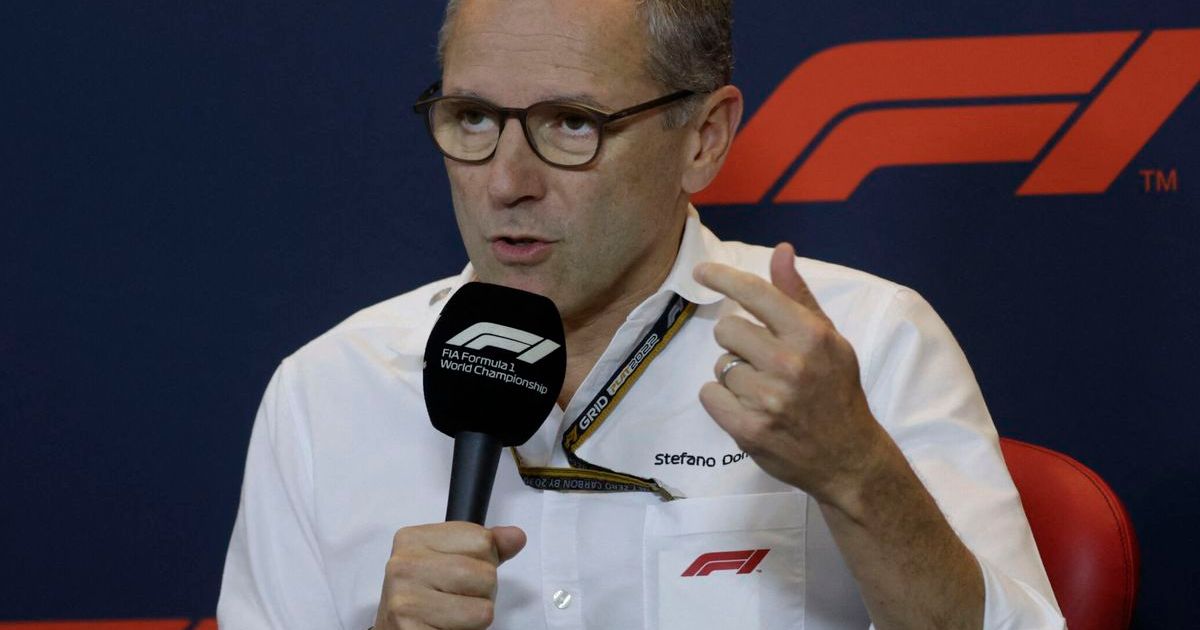
Stefano Domenicali says Formula 1's expansion in the United States — three races on the calendar, sold-out grandstands at every one, and a place inside American pop culture that the sport has spent decades chasing — is still only the opening act.
Speaking at the Autosport Business Exchange on the sidelines of the Miami Grand Prix, the F1 CEO acknowledged the scale of the sport's American transformation while making clear the leadership group sees the current footprint as a baseline, not a destination.
"Well, if you think back, F1 has always been in the US, but randomly, I would say, in terms of presence," Domenicali said. "And now we have three races where the average attendance is huge."
That third race — the Las Vegas Grand Prix added in 2023 — capped a six-year sprint that turned the United States from a fringe market for Formula 1 into one of its most strategically important. Eight years ago Austin's annual headcount sat around 60,000. Today the Circuit of the Americas, Miami International Autodrome and Las Vegas Strip Circuit each draw multiple times that figure across their respective race weekends.
Three races, and more lined up
Domenicali confirmed what has been an open secret in industry circles for some time: more American cities want a piece of the calendar. "Three races and there is a lot of requests to be more in the US," he said.
The sport's leadership has so far resisted the temptation to add a fourth date, conscious that scarcity has been part of what propelled American interest in the first place. Liberty Media's measured approach — three races, each with a distinct character — has avoided the saturation problem that other US sports leagues run into when they expand abroad.
"But we are just at the beginning of our journey in the US," Domenicali continued. "We are not yet [there]."
Culture takes time
The other thread running through the F1 chief's comments was patience. The cultural rehabilitation of Formula 1 in America — from a sport most casual fans associated with Indianapolis once a year, to a bona fide pop-culture fixture with celebrity grids and Netflix-grade narrative arcs — has taken roughly a decade of sustained effort. Domenicali was clear that the work is far from done.
"To change a culture or to evolve the culture takes time," he said. "But the US gives us an opportunity to grow that is tremendous and is big. We are racers — we're going to be in the culture of American fans sooner than what you think."
The 2026 season has only sharpened the stakes. Cadillac's entry as F1's eleventh team — the first American constructor since the original Haas effort in 1986, and arguably the first commercially serious one in a generation — gives the championship an obvious domestic flag-bearer to rally a US audience around. With three races, an American team and a CEO unafraid to repeat the phrase "just the beginning," Formula 1's bet on America is clearly nowhere near being cashed in.
I'm Alex Da Costa, a systems engineer with more than ten years of experience designing and maintaining data-heavy infrastructure. I've been watching Formula 1 since the 2005 season — Alonso's first championship, the year Schumacher's seven-title era finally cracked — and it's been an obsession ever since. Pit Lane F1 is what happens when that IT background meets a lifelong F1 habit. I started this site because the big outlets cover the headline result but rarely the data underneath: why a pit-stop window mattered, how a circuit's lap-record history actually compares, what every driver has done at every venue. So I built it. Race recaps for every Grand Prix since 1950, head-to-head career comparisons, telemetry replays for 2024 onward, and per-circuit deep dives — all from open data sources, fact-checked against multiple references, and written in plain language. The site is run independently. No team, driver, or commercial partner influences what gets published. If you spot a factual error or want to suggest a feature, the contact page is the fastest way to reach me.